> ## Documentation Index
> Fetch the complete documentation index at: https://agno-v2-codex-homepage-20260719-015142.mintlify.site/llms.txt
> Use this file to discover all available pages before exploring further.
# AgentOS Control Plane
> Run components, inspect runs, and manage AgentOS runtimes.
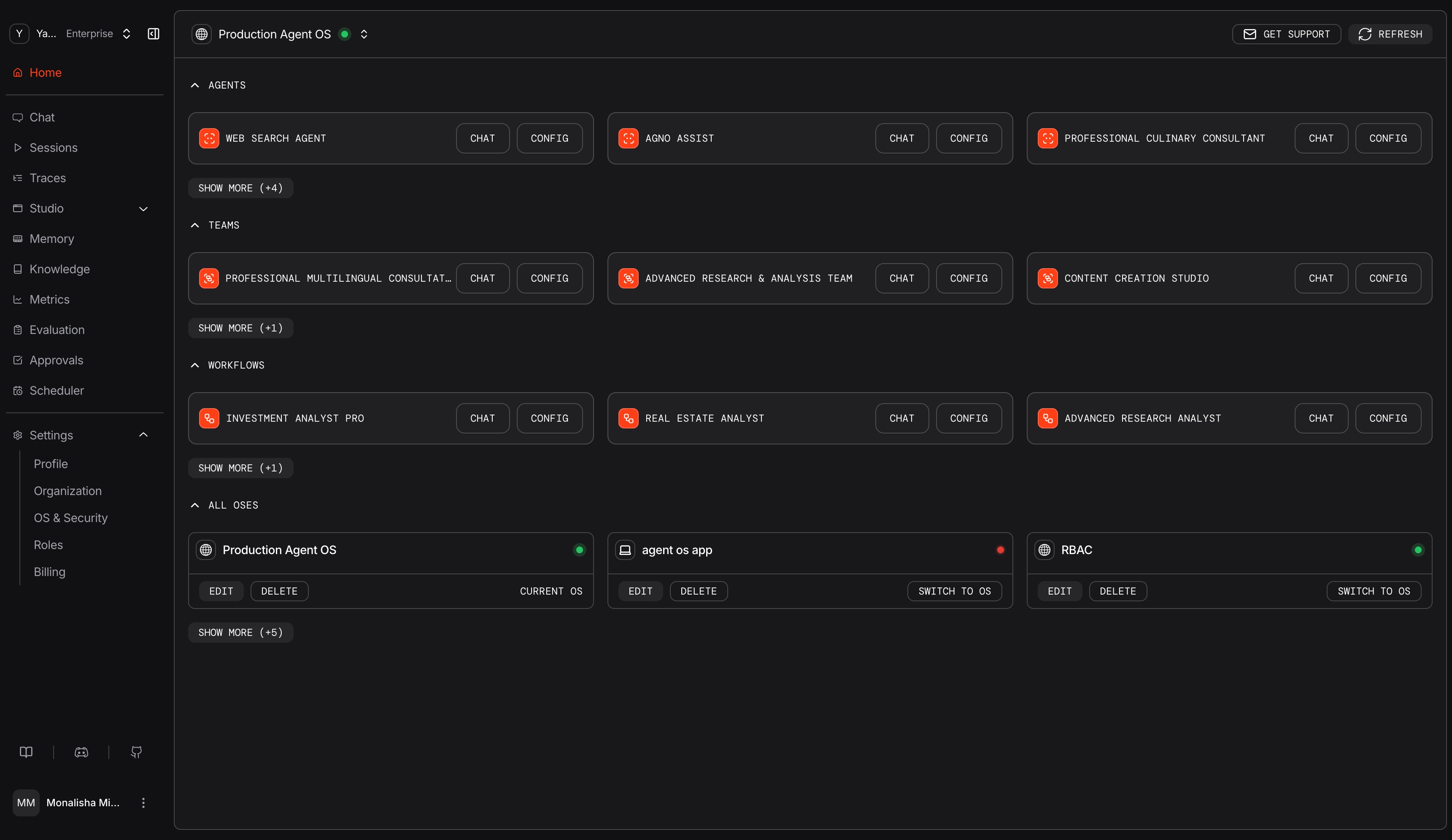
Use the [AgentOS Control Plane](https://os.agno.com) to test agents, teams, and workflows, follow runs from sessions into traces, and manage the state and automation exposed by a connected AgentOS runtime.
 ## Follow Your First Run
Open **Home** and select the local, staging, or production runtime you want to inspect. A green indicator shows that the browser can reach it.
Open **Chat**, choose **Agents**, **Teams**, or **Workflows**, then select a registered component. Start a new session and provide an input.
Open **Sessions** to review stored runs, messages, metrics, session metadata, and summaries when configured.
Open **Traces** to follow instrumented model calls, tool calls, team delegation, and workflow steps. Traces require `tracing=True` and a database available to AgentOS tracing.
## Control Plane Views
Each view reflects capabilities configured on the selected runtime.
| View | Use It To | Runtime Setup |
| ---------- | -------------------------------------------------------------------------------------- | ------------------------------------------------------------------------ |
| Home | Select a runtime and open registered components | Agents, teams, or workflows registered with AgentOS |
| Chat | Run agents and teams, execute workflows, and continue sessions | A registered component |
| Sessions | Inspect stored runs, messages, summaries, and metrics | A database used by the component or AgentOS |
| Traces | Follow instrumented operations, timing, errors, and model token metrics when available | `tracing=True` and a database available to tracing |
| Studio | Compose, test, publish, and version components | A `Registry` and a synchronous AgentOS `db` |
| Memory | Inspect and update records for memory-enabled agents | User memory and a database |
| Knowledge | Add and inspect content in registered knowledge bases | A `Knowledge` instance, contents database, vector database, and embedder |
| Metrics | Review aggregate runs, sessions, users, token usage, and model activity | Stored run and session metrics |
| Evaluation | Review evaluation results stored by the SDK or AgentOS | Evaluation runs persisted to a database |
| Approvals | Review tool arguments and resolve paused executions | An AgentOS `db` and approval-enabled tools |
| Scheduler | Create recurring runs, trigger them manually, and inspect run history | An AgentOS `db` and `scheduler=True` |
## Inspect and Improve Runs
With `tracing=True`, AgentOS stores spans for instrumented agent, team, workflow, model, and tool operations. Trace trees show status, timing, errors, and model token metrics when available. Use them to find the model call, tool argument, member response, or workflow step behind an unexpected result.
Stored sessions provide the surrounding conversation and run history. The Metrics view summarizes run, session, user, token, and model activity. Individual run and session records include timing and cost when available. Evaluation results let you compare component behavior as models, instructions, tools, and knowledge change.
| Task | Guide |
| --------------------------------- | ---------------------------------------- |
| Configure trace storage | [Tracing](/agent-os/tracing/overview) |
| Work with run and session metrics | [Metrics](/sessions/metrics/overview) |
| Build and store evaluations | [Agent Evaluation](/features/evaluation) |
## Build and Manage State
Studio composes agents, teams, and workflows from components registered by the runtime. Save drafts, test them, publish immutable versions, and choose which published version the runtime serves.
Knowledge and memory expose the state used to ground and personalize runs:
* **Knowledge**: Add and inspect content in knowledge bases registered with AgentOS. Ingestion, chunking, embeddings, and storage follow the knowledge configuration in your application.
* **Memory**: For agents with user memory enabled, inspect, create, edit, and delete records stored for a `user_id`.
| Task | Guide |
| --------------------------------- | -------------------------------------------------------- |
| Configure Studio and its Registry | [Studio](/agent-os/studio/introduction) |
| Register and manage knowledge | [Manage Knowledge](/agent-os/knowledge/manage-knowledge) |
| Configure user memory | [Memory](/memory/overview) |
## Operate the Runtime
Approvals persist requests for tool executions that require review. Authorized users can inspect the tool and its arguments, approve or reject the request, and follow its resolution history.
The Scheduler stores cron-based jobs for AgentOS endpoints. Use it to create or update schedules, enable or disable execution, trigger a run immediately, and inspect run history.
| Task | Guide |
| ------------------------------- | ----------------------------------------- |
| Add required or audit approvals | [Approvals](/agent-os/approvals/overview) |
| Configure scheduled execution | [Scheduler](/agent-os/scheduler/overview) |
## Data Path
The browser sends requests to the selected AgentOS endpoint. That runtime executes components, enforces its authorization configuration, and reads or writes the state shown in the Control Plane.
| Layer | Role |
| -------------------- | ----------------------------------------------------------------------------------------------------------- |
| Control Plane | Provides the browser interface and calls the AgentOS endpoint you select |
| AgentOS runtime | Runs components, exposes APIs, and enforces runtime authorization |
| Configured databases | Store sessions, memories, traces, evaluations, approvals, schedules, metrics, and Studio component versions |
| External services | Models, tools, interfaces, telemetry, and custom exporters follow their own configuration and data paths |
The Control Plane reads conversations, traces, memories, and knowledge from the selected runtime and its configured databases. It stores the endpoint and organization metadata needed to connect. Control Plane-managed JWT authorization also stores the private signing key; the runtime receives the corresponding public verification key. Model providers and other external services follow their own configuration. AgentOS anonymous telemetry is separate and can be configured or disabled. See [Telemetry](/telemetry).
## Security and Team Access
Serve live runtimes over HTTPS and configure [Security & Auth](/agent-os/security/overview). The Control Plane can issue RS256 tokens and provides the public verification key for your runtime. JWT scopes control which AgentOS endpoints each role can use. Per-user data isolation is an additional opt-in setting for multi-tenant deployments.
Owners and administrators can invite members from **Settings > Organization**. Default roles cover owners, administrators, and members. Custom roles are available on the Enterprise plan.
| Task | Guide |
| ------------------------------- | -------------------------------------------------------------------------- |
| Connect another runtime | [Connect Your AgentOS](/agent-os/connect-your-os) |
| Configure JWT verification | [Authorization Quickstart](/agent-os/security/authorization/quickstart) |
| Review roles and scopes | [Roles](/agent-os/security/authorization/roles) |
| Isolate persistent data by user | [Per-User Data Isolation](/agent-os/security/authorization/user-isolation) |
## Follow Your First Run
Open **Home** and select the local, staging, or production runtime you want to inspect. A green indicator shows that the browser can reach it.
Open **Chat**, choose **Agents**, **Teams**, or **Workflows**, then select a registered component. Start a new session and provide an input.
Open **Sessions** to review stored runs, messages, metrics, session metadata, and summaries when configured.
Open **Traces** to follow instrumented model calls, tool calls, team delegation, and workflow steps. Traces require `tracing=True` and a database available to AgentOS tracing.
## Control Plane Views
Each view reflects capabilities configured on the selected runtime.
| View | Use It To | Runtime Setup |
| ---------- | -------------------------------------------------------------------------------------- | ------------------------------------------------------------------------ |
| Home | Select a runtime and open registered components | Agents, teams, or workflows registered with AgentOS |
| Chat | Run agents and teams, execute workflows, and continue sessions | A registered component |
| Sessions | Inspect stored runs, messages, summaries, and metrics | A database used by the component or AgentOS |
| Traces | Follow instrumented operations, timing, errors, and model token metrics when available | `tracing=True` and a database available to tracing |
| Studio | Compose, test, publish, and version components | A `Registry` and a synchronous AgentOS `db` |
| Memory | Inspect and update records for memory-enabled agents | User memory and a database |
| Knowledge | Add and inspect content in registered knowledge bases | A `Knowledge` instance, contents database, vector database, and embedder |
| Metrics | Review aggregate runs, sessions, users, token usage, and model activity | Stored run and session metrics |
| Evaluation | Review evaluation results stored by the SDK or AgentOS | Evaluation runs persisted to a database |
| Approvals | Review tool arguments and resolve paused executions | An AgentOS `db` and approval-enabled tools |
| Scheduler | Create recurring runs, trigger them manually, and inspect run history | An AgentOS `db` and `scheduler=True` |
## Inspect and Improve Runs
With `tracing=True`, AgentOS stores spans for instrumented agent, team, workflow, model, and tool operations. Trace trees show status, timing, errors, and model token metrics when available. Use them to find the model call, tool argument, member response, or workflow step behind an unexpected result.
Stored sessions provide the surrounding conversation and run history. The Metrics view summarizes run, session, user, token, and model activity. Individual run and session records include timing and cost when available. Evaluation results let you compare component behavior as models, instructions, tools, and knowledge change.
| Task | Guide |
| --------------------------------- | ---------------------------------------- |
| Configure trace storage | [Tracing](/agent-os/tracing/overview) |
| Work with run and session metrics | [Metrics](/sessions/metrics/overview) |
| Build and store evaluations | [Agent Evaluation](/features/evaluation) |
## Build and Manage State
Studio composes agents, teams, and workflows from components registered by the runtime. Save drafts, test them, publish immutable versions, and choose which published version the runtime serves.
Knowledge and memory expose the state used to ground and personalize runs:
* **Knowledge**: Add and inspect content in knowledge bases registered with AgentOS. Ingestion, chunking, embeddings, and storage follow the knowledge configuration in your application.
* **Memory**: For agents with user memory enabled, inspect, create, edit, and delete records stored for a `user_id`.
| Task | Guide |
| --------------------------------- | -------------------------------------------------------- |
| Configure Studio and its Registry | [Studio](/agent-os/studio/introduction) |
| Register and manage knowledge | [Manage Knowledge](/agent-os/knowledge/manage-knowledge) |
| Configure user memory | [Memory](/memory/overview) |
## Operate the Runtime
Approvals persist requests for tool executions that require review. Authorized users can inspect the tool and its arguments, approve or reject the request, and follow its resolution history.
The Scheduler stores cron-based jobs for AgentOS endpoints. Use it to create or update schedules, enable or disable execution, trigger a run immediately, and inspect run history.
| Task | Guide |
| ------------------------------- | ----------------------------------------- |
| Add required or audit approvals | [Approvals](/agent-os/approvals/overview) |
| Configure scheduled execution | [Scheduler](/agent-os/scheduler/overview) |
## Data Path
The browser sends requests to the selected AgentOS endpoint. That runtime executes components, enforces its authorization configuration, and reads or writes the state shown in the Control Plane.
| Layer | Role |
| -------------------- | ----------------------------------------------------------------------------------------------------------- |
| Control Plane | Provides the browser interface and calls the AgentOS endpoint you select |
| AgentOS runtime | Runs components, exposes APIs, and enforces runtime authorization |
| Configured databases | Store sessions, memories, traces, evaluations, approvals, schedules, metrics, and Studio component versions |
| External services | Models, tools, interfaces, telemetry, and custom exporters follow their own configuration and data paths |
The Control Plane reads conversations, traces, memories, and knowledge from the selected runtime and its configured databases. It stores the endpoint and organization metadata needed to connect. Control Plane-managed JWT authorization also stores the private signing key; the runtime receives the corresponding public verification key. Model providers and other external services follow their own configuration. AgentOS anonymous telemetry is separate and can be configured or disabled. See [Telemetry](/telemetry).
## Security and Team Access
Serve live runtimes over HTTPS and configure [Security & Auth](/agent-os/security/overview). The Control Plane can issue RS256 tokens and provides the public verification key for your runtime. JWT scopes control which AgentOS endpoints each role can use. Per-user data isolation is an additional opt-in setting for multi-tenant deployments.
Owners and administrators can invite members from **Settings > Organization**. Default roles cover owners, administrators, and members. Custom roles are available on the Enterprise plan.
| Task | Guide |
| ------------------------------- | -------------------------------------------------------------------------- |
| Connect another runtime | [Connect Your AgentOS](/agent-os/connect-your-os) |
| Configure JWT verification | [Authorization Quickstart](/agent-os/security/authorization/quickstart) |
| Review roles and scopes | [Roles](/agent-os/security/authorization/roles) |
| Isolate persistent data by user | [Per-User Data Isolation](/agent-os/security/authorization/user-isolation) |